Electricians - UK Directory

top of page

Reliable Pat Testing London

From £49. NAPIT Registered Pat Testers.
Business Safety Compliance Made Simple.
For the Best Service and Prices in London.

Same day / next day service available.

Open 7 Days a week From 7 am to 9 pm, For Every Business Sector, Small, Medium & Large.

Pat Testing, Eicr testing, Emergency light testing, Fire risk assessments, Gas Safety, Floor plans, Fire safety services, Legionella Risk Assessments, EPC, Fire Door Compliance, Asbestos Surveys, and Carbon Monoxide Alarms.

We have No Hidden extras Like Parking Congestion charges or ULEZ, it's all included in our prices.

London Pat Testing | London Fire Risk Assessments | London Gas Safety Certificates | London Fire Safety 
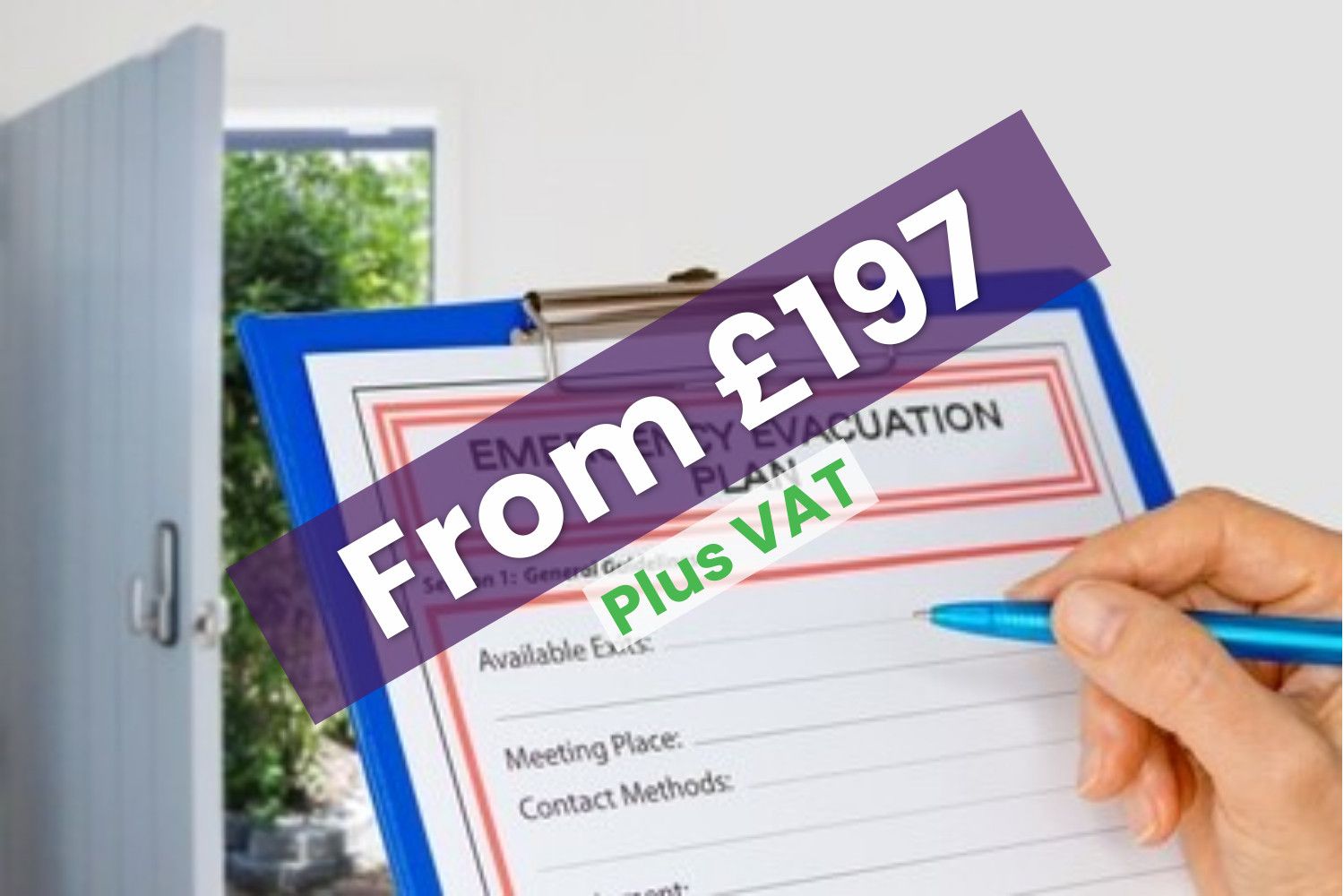
Evacuation Plans For Landlords & All Business Sectors

£197.00
Additional floor(s) at £100 per extra floor
Please choose
Certificate delivery
From £197 plus VAT
1
Product Details

London fire evacuation plan - information. From £197.00

We have multi-service engineers and surveyors to save you multiple service visits. We have everything covered under one order.


A London evacuation plan, also known as FEEP, is an exit plan that includes a written document outlining the actions to be taken by all staff in the event of a fire and the arrangements for calling the fire brigade.


General Fire Notice For London small business properties, this could take the form of a simple fire action sign posted in positions in your communal areas where staff and relevant persons can read it and become familiar with its contents.


Staff Fire Notice for High fire risks or large properties in London will need a more detailed emergency evacuation plan, which takes account of the findings of the Fire risk assessment, where the staff could be at significantly higher risk in their location. In addition, notices giving clear
Instructions of the routine to be followed in case of fire.


In some instances, you should nominate persons to implement the fire action plan and give them adequate training in firefighting and evacuation procedures. The following items should be considered, where appropriate, for your London business.


  • Fire evacuation strategy
  • Action on discovering a fire
  • Action on hearing the fire alarm
  • Calling the fire brigade
  • Power/process isolation
  • Identification of key escape routes
  • Fire wardens/marshals
  • Places of assembly and roll call
  • Firefighting equipment provided
  • Training required
  • Personal Emergency Evacuation Plan
  • Liaison with emergency services

London Fire evacuation strategy


You need to consider how you will arrange the evacuation of the premises if there is a fire, your risk assessment, and the other fire precautions you have put in place.


Simultaneous Evacuation

In most premises, the evacuation in the event of a fire will involve everyone reacting to the warning signal given when a fire is discovered, then making their way out using escape plans and getting people to a place of safety.
This is known as a simultaneous evacuation, and the sounding of the alarm over the fire warning system typically initiates it.


Vertical Phased Evacuation.

In some larger complexes or high-rise properties, emergency arrangements are designed to allow people not at immediate risk from a fire to delay evacuation.


It may be appropriate to start the evacuation by initially evacuating only the area closest to the fire and warning others to stand by. This is normally done by immediately evacuating the floor where the fire is located and the floor above. The other floors are then evacuated individually to avoid congestion on the escape routes. The rest of the people are then evacuated if necessary. The fire warning system should be able to give two distinctly different signals (warning and evacuation) or appropriate voice messages.


Horizontal phased evacuation in hospitals and care homes: the floor may be divided into several fire-resisting compartments, and the occupants are moved from the compartment involved in the fire to the adjacent compartment and, if required, to move again.


Depending on the fire situation, vertical evacuation may be necessary. Because this type of evacuation takes extra time, other fire precautions may be required, as below.

  • Voice alarm systems
  • Fire control points
  • Compartmentalization of the premises using fire-resisting construction
  • Sprinklers in buildings where the top floor is 30 meters or more above ground level

Staff Alarm Evacuation (Silent Alarm)

In some instances, it may not be appropriate for a general alarm to start immediate evacuation of London Cinemas and Theatres. This could be because of the number of people present and the need for the staff to put pre-arranged plans in place first for the safe evacuation of the premises into action.


In such circumstances, a staff alarm can be given by fire records, personal pagers, discreet sounders, or a coded phrase on a public address system. Following the staff alarm, a more general alarm signal can be given, and a simultaneous or phased evacuation can be started. The general alarm may be activated automatically if manual initiation has not occurred within a predetermined time.


Defend in Place

This strategy may be considered in London blocks of flats, each with a minimum 60-minute fire-resistant compartment. It may also be considered in hospitals or nursing homes, where patients are connected to life-supporting equipment and cannot be moved.


The concept allows the occupants to stay put and enable the fire service to extinguish the fire. They will initiate a full evacuation if the fire spreads and cannot be controlled. In the case of patients connected to life-supporting equipment, a decision has to be made about which option is the best: stay or move. Either way, the patient would be at serious risk.


You should only plan to use defend-in-place, phased evacuation schemes, or a staff alarm system after seeking the advice of a competent person and the fire and rescue service.


Action on hearing the fire alarm

Every person must sound the nearest fire alarm immediately upon discovering a fire. The plan should include the method of raising the alarm in case of fire.


The plan should instruct all personnel upon hearing the fire alarm to act following the agreed FEEP strategy, and if a fire warden’s scheme is in force, they, on hearing the alarm, should proceed to pre-determined positions to assist members of the public and staff
to leave the building by the nearest safe route.


Lifts and escalators should not be used due to possible electrical failure unless they are part of a Personal Emergency Evacuation Plan.
Personnel should not re-enter the building except for the Fire Team.


Calling the fire brigade

The Fire Service should also be informed immediately, either by the switchboard operator or the person discovering the fire, depending on the conditions:

  • Work Time—The Switchboard operator should be familiar with the emergency evacuation plan and ensure necessary extensions are switched through when the switchboard is unattended.
  • Other Times—The Remaining Staff (Cleaners, caretakers, etc.) should also be familiar with the procedure. In any case, the most senior official should ensure the Fire Service has been called.

Power/process isolation

Close–down Procedure—Adopt your own ‘Close-down’ procedure as appropriate. Identification of key escape routes In premises where members of the public or persons unfamiliar with the layout of the premises are present, means should be available to identify the key escape routes. They could include schematic drawings and, most importantly, emergency escape and exit signs.


The London Fire Evacuation Plan Certificate is returned between 24 and 48 hours after a site visit. It is sent via email only in PDF format.

*Please note. Certification will not be released until payment has been received unless you are an existing account customer or have been pre-approved.


Key Info for Clients

  • Payment Terms: Orders below £300 must be paid in advance.
  • Cancellation Policy: You can cancel up to 48 hours before your scheduled visit for a full refund. Cancellations made less than 48 hours in advance are non-refundable, as we've allocated engineers and resources to your job.
  • Access Requirements: Engineers must have access to the premises at the scheduled time. If access is denied or no one is available to grant entry, full payment for the service is required to cover allocated resources.
  • Appointment Times: Booking times are guide times (AM/PM) due to potential London transport delays and job extensions. We aim to meet these times and will communicate any necessary adjustments.

Please ensure availability for engineer access and note that while we strive to adhere to scheduled times, flexibility helps us maintain service quality.

Evacuation Plans For Landlords & All Business Sectors

Our Coverage Area

London Pat Testing Areas

We operate across the whole of North, East, South and West London and cover all of the boroughs within the London regions. Our services are available to clients across London for either commercial, residential or construction purposes.

​

We service outside The M25 of London.

Please contact us for further information.

​

It's easy to book the service you require.

Contact

Portable Appliance Testing (PAT) in London

​

METRO PAT FM LTD provides professional PAT testing across London for businesses, landlords, commercial premises and construction sites.

We work with organisations of all sizes, including offices, shops, hotels, GP practices, dental practices, landlords and construction companies, providing reliable electrical safety testing throughout Central, North, South, East and West London.

​

PAT testing involves examining electrical appliances and equipment to help identify damage, deterioration or electrical faults that could make them unsafe to use. This normally includes a visual inspection together with appropriate electrical tests carried out by a competent technician.

​

PAT Testing and Electrical Safety

​

Businesses and those responsible for workplace electrical equipment have a duty to ensure that equipment is maintained in a safe condition.

​

PAT testing can form an important part of an effective electrical maintenance programme, particularly for equipment that is regularly used, moved frequently or exposed to demanding working environments.

The appropriate inspection and testing frequency will depend on factors such as the type of equipment, how it is used and the environment in which it operates.

​

METRO PAT FM LTD provides PAT testing for a wide range of electrical equipment, including Class I, Class II and SELV appliances, as well as 110V, 240V and 3-phase equipment used on construction sites.

​

PAT Testing Certificates

​

Following testing, we can provide a PAT testing certificate and testing records covering the electrical equipment inspected.

​

These records can help businesses, landlords and responsible persons manage their electrical safety programme and demonstrate that appropriate inspection and testing has been carried out.

We provide PAT testing for:

​

Offices and commercial premises, shops and retail businesses, hotels and hospitality businesses, landlords and rental properties, medical and dental practices, construction sites, schools and other organisations across London.

​

PAT Testing Across London

​

Whether you require testing for a small number of appliances or a larger commercial site, METRO PAT FM LTD can provide a PAT testing service tailored to your requirements.

​

We also provide EICR testing, emergency lighting testing, fire alarm testing, fire extinguisher testing, fire risk assessments, fire door compliance inspections, Legionella risk assessments and evacuation plans.

​

Contact METRO PAT FM LTD

​

Need PAT testing in London?

​

View our PAT testing deals and book online, or contact METRO PAT FM LTD to discuss your requirements.

Call: (0800) 014 6728 / (020) 3600 9964
Email: admin@metro-pat.co.uk

LONDON PAT TESTING

CONTACT US

Book your Electrical and Safety compliance services online, or get in touch to let us know what you need! You can always count on Metro PAT FM LTD Limited.

Phone Lines Open From 7 am to 9 pm 7 Days a Week

​

CALL - (0800) 014 6728 / (020) 3600 9964

EMAIL - admin@metro-pat.co.uk

  • Facebook
  • Metro PAT is on Instagram
  • Metro PAT is on Twitter
DBS CHECKED ACCREDITATION

Thanks for submitting!

METRO PAT FM LTD LOGO

Order line: (0800) 014 6728

  • Facebook
  • Metro Pat on YouTube
  • Metro-PAT Testing London Instagram
  • Metro Pat on Twitter
  • Metro PAT Linked In

METRO PAT FM LTD, registered as a limited company in England and Wales under the company number: 15304351

​

Our branches:


Branch1 (HQ): N/A

Branch 2: Metro PAT FM LTD, 78 York Street, London, W1H 1DP

Branch 3: Metro PAT FM LTD, 36 Notcutt House, Southwark Bridge Road, SE1 9EU

Branch 4: Metro PAT FM LTD, Saunders House, 52-53 The Mall, London, W5 3TA

​

Cheap PAT Testing London

​

Service areas: Central London, North London, South London, West London, East London

PAT Testing London, EICR Testing, Fire Alarm Testing, London Fire Risk Assessments, Fire Extinguisher Testing, Evacuation Plans, Floor Plans, Legionella Testing, Asbestos Surveys, Gas Safety Certification, and more.

​​

© 2026 Metro PAT FM LTD | All Rights Reserved T&Cs Privacy Policy

bottom of page